They don't come along very often. Supernova SN 2014J was discovered by astronomer Steve Fossey, of University College London and four undergraduate students on 21st January. It is a Type Ia supernova, the closest Type Ia supernova in the last 40 years. Type 1a supernova's are very useful as they produce a consistent peak of luminosity due to the uniform mass of white dwarfs that explode via the accretion mechanism. The value is very stable and allows these explosions to be used as standard candles to measure the distance to their host galaxies. This is because the visual magnitude of the supernova depends primarily on the distance.
Unfortunately, the supernova may put on a great show, but the Scottish weather doesn't always play ball. I set up my scope (an 8" reflector) and camera last night in my garden and took some images. Between the clouds and the threatening rain I only got about 10 minutes of useful imaging before I had to give up. However, the supernova is really obvious once you find the target. I saw it straight away. The image above shows M81 and M82. M82 is the lower cigar shaped Galaxy and in the mid-upper left you can see Supernova 2014 J.
If we zoom in on M82, the supernova is quite clear as an orange spot to the upper left of the Galaxy.
Checks by astronomers have found that the supernova was visible on images taken as early as January 15th. Indications were that the supernova was discovered approximately 14 days before maximum light, so it is expected to get brighter over the following fortnight, probably bright enough to be visible with binoculars throughout the Northern Hemisphere within a couple of days. It should reach maximum brightness of around magnitude 8.5 or so with the next two weeks.
A keen amateur astronomer located on the West Coast of Scotland. Usually found fighting the damn Scottish weather
Showing posts with label Astronomy. Show all posts
Friday, 24 January 2014
Tuesday, 14 January 2014
Jupiter and the Moon
If you are lucky enough to have clear skies tonight, and don't count on it in Scotland, you may be able to see Jupiter pass within six degrees, and a little to the left, of the Moon. Now, to be clear, this is not technically NOT a conjunction, but they will look close. Technically conjunctions are defined as occuring when two astronomical objects have either the same right ascension or the same ecliptical longitude, normally when observed from the Earth. This can happen between planets, planets and the Moon, sometimes (very rarely) more than two objects may be involved. Often they just appear close, sometimes much closer, and sometimes very close. Last year was better for the Moon and Jupiter. The image below shows a Stellarium screenshot of how it will appear tonight from Scotland.
Last year I was lucky enough to get a decent photo of Jupiter and the Moon when they appeared slightly closer in the sky . The photo below is a composite shot, but shows their actual positions.
I took three separate images, as it is impossible to capture all the detail in one exposure. I took one photo of the Moon, one of Jupiter and one of Jupiter's moons, all using a Fuji high zoom bridge camera. I then built the image in Gimp. If you have clear skies, head out for a look. Better still, take a photo!
Last year I was lucky enough to get a decent photo of Jupiter and the Moon when they appeared slightly closer in the sky . The photo below is a composite shot, but shows their actual positions.
I took three separate images, as it is impossible to capture all the detail in one exposure. I took one photo of the Moon, one of Jupiter and one of Jupiter's moons, all using a Fuji high zoom bridge camera. I then built the image in Gimp. If you have clear skies, head out for a look. Better still, take a photo!
Wednesday, 1 January 2014
New Year Discovery
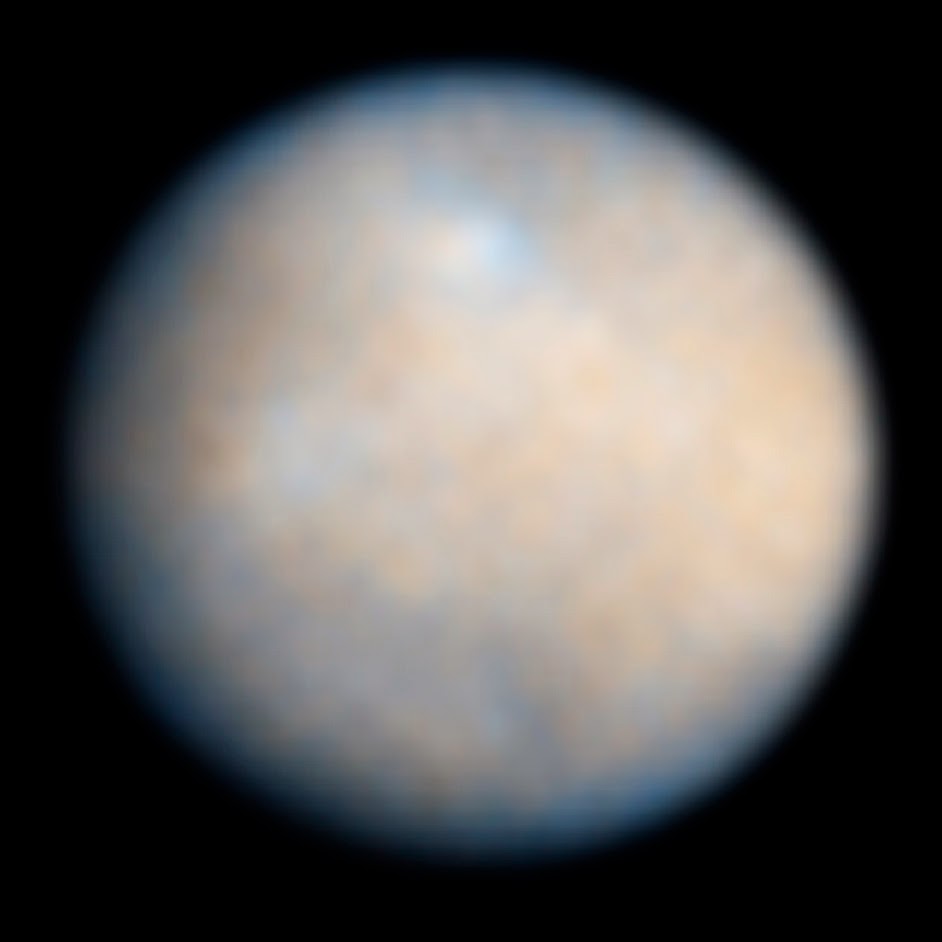
On the first day of a new century, 1 January 1801, the astronomer Giuseppe Piazzi, working at Palermo observatory in Sicily discovered what he first thought was a tail-less comet. After a series of observations, interrupted by illness; and once its orbit was calculated, he realised he had found a 'new planet'. It was named Ceres after the Roman goddess of agriculture and the patron goddess of Sicily. It fitted nicely within Bodes law. between Mars and Jupiter, that strange algebraic “formula” law which seemed to predict the orbital distances of the planets and had just roughly predicted the semi-major axis of Uranus's orbit. Later observations however showed it to be rather small for a Planet and then more and more 'objects' of a similar nature were found reducing Ceres to what was thought to be the largest asteroid. Now though Ceres has had it's nature changed again, and it is now the second largest of what are called 'Dwarf Planets', Pluto being the largest.
Ceres can be tricky to find. It is often just on the verge of human eyesight, even from a dark site, but binoculars and small telescopes show it as a faint star like object. At the moment it can be found using binoculars in the constellation of Virgo, in the early hours of the morning. Ceres is due to be visited by the NASA spacecraft Dawn in 2015, the same year as New Horizons will fly-by Pluto. We should therefore get two good looks at two dwarf planets. Both make interesting targets for a number of reasons but should provide clues as to the origin of the solar system. At the moment, if you get a chance, see if you can find Ceres. It is an interesting spot and many astronomers spend a lifetime without ever giving it notice. The other dwarf planets are a much harder proposition to see.
Sunday, 6 October 2013
Dark Sky Threat
I read with horror the story that Astronomers and land charities have warned that Britain's only Dark Sky Park (pictured) is being threatened by applications for wind turbines. Galloway Forest Dark Sky Park (DSP), in Scotland, secured its 'Dark Sky' status in 2009. But now the Astronomer Royal for Scotland, the John Muir Trust and the Scottish Wild Land Group have written to the Scottish government, asking it to rule out wind farms in the vicinity.
It seems there have been nine proposals for turbines near the park's observatory. Some of the applications had been rejected, but having one approved could open the door for further development. The MOD and Aviation Authority safety requirements mean that wind turbines must be illuminated by infra-red light and, in some areas used regularly for training or search and rescue, visible light illumination may also be needed. Turbines near the Gallway dark sky park could fall into the latter category, and the campaigners said it would affect both the ability of astronomers to use sensitive equipment, and the visibility of stars, galaxies, comets and northern lights. The group has called for the park to be given protection similar to that afforded to areas of wild land, and has called on the Scottish government to update planning policy to rule out the construction of wind farms around the park.
This facility is the only Dark Sky Park in Britain, although both Exmoor and the Brecon Beacons national parks have been awarded Dark Sky Reserve status. Gallway DSP is also home to the world's only publicly accessible, research-grade observatory within a Gold Tier Dark Sky Park. Problem we have is the DSP was open by the Scottish government and praised for being a first, this same government is also pushing renewables such as wind turbines.
I urge anyone out there with an interest is saving our Dark Sky Park to get involved in promoting this threat to our world class site. If we loose it, we wont ever get it back
It seems there have been nine proposals for turbines near the park's observatory. Some of the applications had been rejected, but having one approved could open the door for further development. The MOD and Aviation Authority safety requirements mean that wind turbines must be illuminated by infra-red light and, in some areas used regularly for training or search and rescue, visible light illumination may also be needed. Turbines near the Gallway dark sky park could fall into the latter category, and the campaigners said it would affect both the ability of astronomers to use sensitive equipment, and the visibility of stars, galaxies, comets and northern lights. The group has called for the park to be given protection similar to that afforded to areas of wild land, and has called on the Scottish government to update planning policy to rule out the construction of wind farms around the park.
This facility is the only Dark Sky Park in Britain, although both Exmoor and the Brecon Beacons national parks have been awarded Dark Sky Reserve status. Gallway DSP is also home to the world's only publicly accessible, research-grade observatory within a Gold Tier Dark Sky Park. Problem we have is the DSP was open by the Scottish government and praised for being a first, this same government is also pushing renewables such as wind turbines.
I urge anyone out there with an interest is saving our Dark Sky Park to get involved in promoting this threat to our world class site. If we loose it, we wont ever get it back
Saturday, 5 October 2013
First Light
Like all good telescopes, all good blogs have first light. It's that moment when they get used for the first time. I have had blogs before but after a while I tend to stop writing, it's the pressure of time really. This time I don't intend to pressure myself to write as much as possible, I will just write when I can. So, here's to Scottish Astronomy, that constant battle of dark skies versus terrible weather.
Subscribe to:
Posts (Atom)